
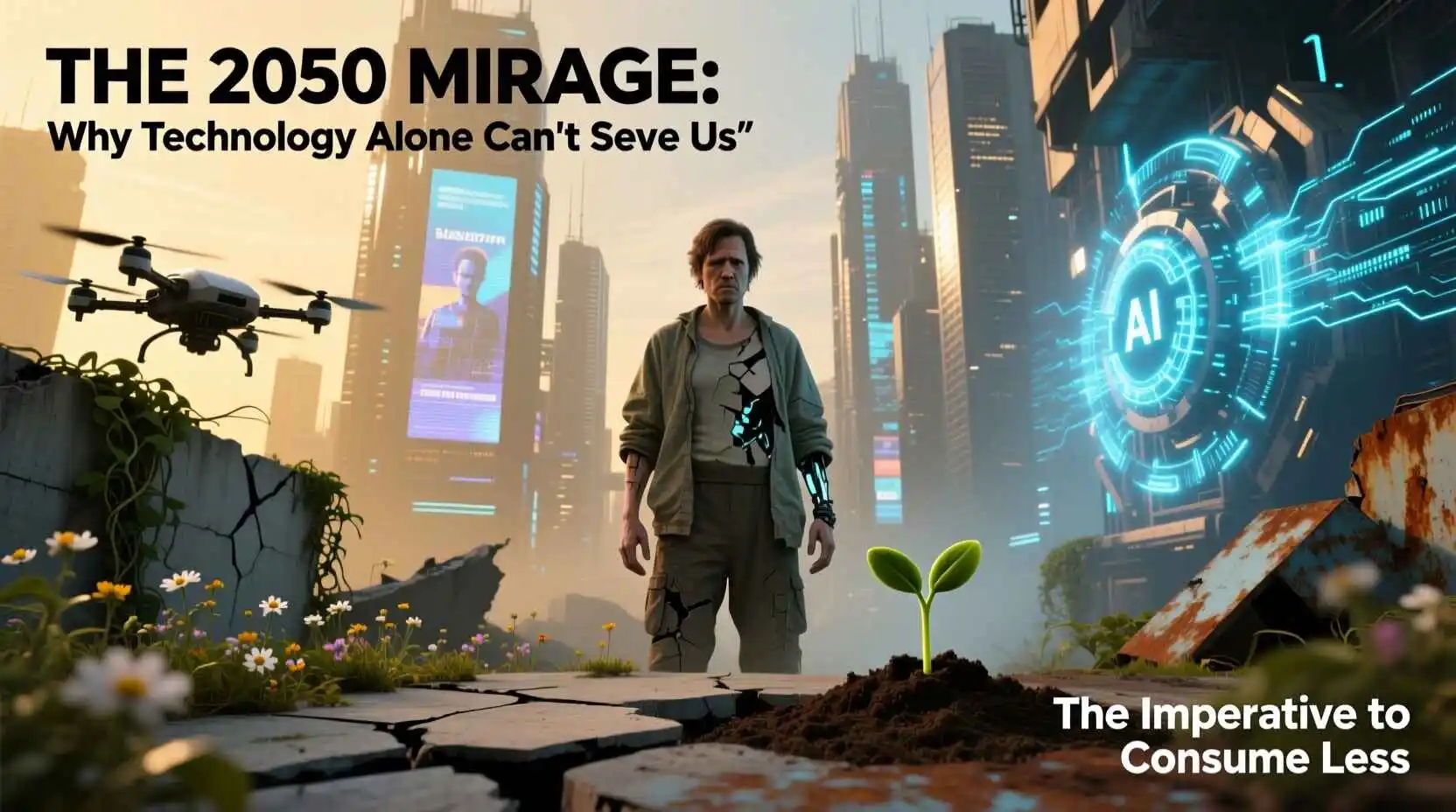

The Hard Truth About Net-Zero 2050: It’s Not Just About Technology, It’s About Less
The year is 2050. The headlines declare it: humanity has reached net-zero. A global symphony of advanced technologies hums in the background—vast solar farms shimmer in deserts, forests of colossal wind turbines churn offshore, and a fleet of sleek electric vehicles glides silently along smart highways. Direct air capture plants, the size of small cities, vacuum decades of carbon dioxide from the atmosphere. It is a portrait of triumph, a testament to human ingenuity. We have engineered our way out of the climate crisis.
This is the story we are often told. It is a comforting narrative, one that promises a future where we do not have to change how we live, only how we power our lives. It is a story that places our faith squarely in the boundless potential of technology to solve the monumental problems we have created. It is also, in all likelihood, a dangerous fantasy.
Beneath this gleaming, high-tech facade lies a profound and uncomfortable truth that is being systematically ignored in mainstream climate discourse: the math simply does not add up. The exclusive focus on a technology-driven transition to net-zero by 2050 is colliding with a series of insurmountable timing problems, resource constraints, and physical limitations. Our relentless pursuit of a green energy revolution, while absolutely essential, is creating a new set of colossal challenges that we are not prepared for.
The silent, unspoken assumption underpinning the net-zero-by-2050 narrative is that we can decouple our ever-growing appetite for material goods, energy, and services from the environmental destruction it causes. We are led to believe that we can have our cake and eat it too—that we can continue to expand the global economy, consume more, and travel more, all while magically erasing our carbon footprint with futuristic machines.

This is a dangerous delusion. While technology is a critical part of the solution, it cannot be the entire solution. To believe otherwise is to ignore the fundamental laws of physics, economics, and ecology. We are running out of time to build our way out of this crisis. The sheer scale of the transition required is so vast, the materials needed so immense, and the time so short, that a strategy based solely on building more is destined to fail.
This is not an argument against renewable energy or technological innovation. It is a plea for a dose of reality. It is a call to have the conversation that no one in power seems willing to have: the conversation about consumption. We must confront the fact that the only viable path to a stable climate and a just future requires not just a technological revolution, but a social and cultural one. It requires us, especially in the wealthy world, to fundamentally rethink what enough looks like. It requires us to talk about cutting consumption.
The Grand Promise and the Hidden Flaws of the Net-Zero Narrative
The concept of “net-zero” has become the North Star for global climate policy. Enshrined in the Paris Agreement and adopted by corporations and governments worldwide, it presents a clear, seemingly achievable goal: to balance the amount of greenhouse gases we emit with the amount we remove from the atmosphere. The dominant pathway to achieving this by mid-century rests on two pillars: a rapid transition to a zero-carbon energy system and the deployment of technologies to remove residual emissions. This narrative is compelling, but a closer examination reveals deep structural flaws.
The Allure of the Techno-Fix
The seductive power of the technology-centric net-zero narrative lies in its political and social convenience. It offers a vision of progress that is familiar and non-threatening. It does not ask us to question the foundational assumptions of our economic system, which is predicated on perpetual growth. Instead, it reframes the climate crisis as an engineering problem, a challenge to be met with innovation, investment, and human cleverness.
This narrative promises a win-win scenario. We can transition to a green economy, create millions of new jobs in clean energy sectors, and maintain our standards of living, all while averting climate catastrophe. It allows politicians to announce ambitious-sounding targets without having to champion policies that might be unpopular with voters or powerful industries. It allows corporations to pledge to become “net-zero” by 2050, a date conveniently far enough in the future to avoid immediate, disruptive changes to their business models, while continuing business-as-usual in the present.
The core components of this vision are well-known:
- Electrify Everything: Replace all fossil fuel-based processes—transportation, heating, industrial manufacturing—with electricity.
- Decarbonize the Grid: Generate all of that electricity from renewable sources like solar, wind, hydro, and geothermal, supplemented by nuclear power.
- Deploy Carbon Removal: For the emissions that are impossible or prohibitively expensive to eliminate—such as from aviation or certain industrial processes—use a combination of nature-based solutions (like reforestation) and technological solutions (like Direct Air Capture) to suck carbon out of the air.
On the surface, this plan seems logical and comprehensive. However, when we move from the conceptual to the practical, from the global aggregate to the granular details of implementation, the timeline of 2050 begins to look less like a target and more like a cliff.
The Insurmountable Timing Problem
The primary, and perhaps most fatal, flaw in the net-zero-by-2050 narrative is the problem of scale and time. The transition we need to undertake is not a simple upgrade; it is the complete overhaul of the entire energy and material foundation of industrial civilization in less than three decades. To grasp the sheer magnitude of this task, consider the following:
- The Energy Transition: Global energy demand is enormous, and it is still growing. To replace the energy we currently get from fossil fuels with renewables would require building an unprecedented number of solar panels, wind turbines, batteries, and new transmission lines. For example, some estimates suggest that to meet global climate goals, the world needs to install the equivalent of the world’s largest solar park every single day for the next decade. The rate of deployment required is staggering, far exceeding anything we have achieved historically. The supply chains for critical minerals like lithium, cobalt, nickel, copper, and rare earth elements are already under immense strain and are projected to face severe shortages. Mining and processing these materials at the required scale would have its own massive environmental and social impacts, from deforestation and water pollution to human rights abuses in mining communities.
- The Infrastructure Lock-in: Our economies are built around fossil fuels. We have trillions of dollars worth of infrastructure—power plants, pipelines, refineries, cargo ships, airplanes, factories, and vehicles—that was designed to last for decades. Much of this infrastructure is relatively new and has not yet paid back its capital investment. The idea that we can simply “turn off” this vast, embedded system and replace it in 25 years is economically naive. It ignores the powerful forces of inertia and vested interests. Every new coal plant built today, every new gasoline-powered car sold, is a piece of infrastructure that “locks in” future emissions for its operational lifetime, making the 2050 goal even harder to reach.
- The Carbon Removal Fantasy: Perhaps the most dangerous element of the narrative is the reliance on future carbon removal technologies. Direct Air Capture (DAC), the process of chemically scrubbing CO2 from the ambient air, is currently in its infancy. It is incredibly expensive and energy-intensive. To build the thousands of DAC plants needed to make a significant dent in atmospheric carbon levels by 2050 would require a global industrial effort on a scale comparable to, or even greater than, the global fossil fuel industry itself. It would consume a vast amount of the very clean energy we are struggling to produce. Relying on these technologies that do not yet exist at scale is a monumental gamble. It is like a patient with a terminal disease planning on a cure that is still in the early stages of animal testing, while making no changes to their destructive lifestyle. It creates a moral hazard, allowing emitters today to justify continued pollution by promising that a future generation will clean up the mess.
The Jevons Paradox: The Efficiency Trap
Another critical flaw in the technology-only approach is a well-documented economic phenomenon known as the Jevons Paradox, or the rebound effect. Named after the 19th-century economist William Stanley Jevons, it observes that as technological progress increases the efficiency with which a resource is used, the total consumption of that resource tends to increase, not decrease.
Jevons observed this with coal. As more efficient steam engines were developed, making coal a more cost-effective power source, the demand for coal did not fall; it exploded, as coal became viable for a vast array of new applications. The same principle applies today to energy and materials.
For example, as we make cars and appliances more energy-efficient, the cost of “fueling” them goes down. This can lead people to simply use them more, or to spend the money they saved on other energy-consuming goods and services, thus wiping out the initial efficiency gains. A household that installs solar panels and sees their electricity bill drop to zero might feel justified in buying a larger, more powerful electric vehicle or taking more international flights, negating the carbon savings from their solar investment.
On a macroeconomic scale, the pursuit of “green growth” can trigger the Jevons Paradox. As we make production processes more efficient and less resource-intensive, we lower the cost of goods, which can stimulate higher levels of consumption and economic growth, leading to a net increase in total resource use and emissions. The pursuit of efficiency, without a corresponding constraint on overall consumption, can inadvertently accelerate the very problem it is trying to solve.
The net-zero-by-2050 narrative, with its exclusive focus on technological efficiency and substitution, is walking directly into this trap. It fails to address the fundamental driver of environmental destruction: the relentless expansion of material and energy throughput in our economic system. It assumes we can infinitely decouple growth from impact, a proposition for which there is no historical precedent and mounting evidence to the contrary.
The Elephant in the Room – The Case for Cutting Consumption
If the technology-only pathway is a mirage, then what is the alternative? The answer lies in confronting the one variable that is consistently left out of the equation: consumption. Specifically, the excessive and unsustainable levels of consumption in high-income nations. This is not a popular topic. It challenges the core tenets of modern capitalism and the consumerist lifestyle that defines the global North. But the physics and mathematics of our planetary boundaries are indifferent to our political discomfort. We must talk about cutting consumption.
Defining the Problem: Affluence as the Primary Driver of Impact
To understand why we must cut consumption, we must first understand what is driving our environmental crisis. A simple and powerful equation, known as the IPAT equation, helps to frame this discussion:
Environmental Impact (I) = Population (P) x Affluence (A) x Technology (T)
- Population (P): The number of people on the planet.
- Affluence (A): The level of consumption per person, often measured as GDP per capita.
- Technology (T): The environmental impact per unit of consumption, which can be positive (e.g., efficient technology) or negative (e.g., polluting technology).
For decades, the climate debate has been dominated by discussions about Technology (T) and, to a lesser extent, Population (P). We talk about deploying clean tech and about the need for family planning in developing countries. But the most powerful lever in the equation, Affluence (A), is almost entirely absent from the conversation, especially in wealthy nations.
The data is unequivocal. A tiny fraction of the global population is responsible for the vast majority of historical and current emissions. The world’s richest 10% of people are responsible for nearly half of all lifestyle consumption emissions. The average citizen of the United States consumes and emits more than ten times the global average. The disparity is staggering. The carbon footprint of a person in a high-income country is not just a little bit larger than that of a person in a low-income country; it is an order of magnitude larger.
This means that the climate crisis is not a problem of “humanity” as a whole; it is a problem of a specific, affluent subset of humanity. The lifestyles of the rich and, increasingly, the global middle class, are fundamentally unsustainable. Our high-consumption lifestyles, built on a foundation of fossil fuels and resource extraction, are the primary engine of ecological destruction.
The current net-zero narrative asks us to focus only on the “T” in the equation, making our consumption more efficient. But it ignores the “A.” It ignores the fact that even if we were to make our consumption 100% efficient with clean technology, the sheer scale of that consumption in the wealthy world would still exceed the planet’s capacity to regenerate resources and absorb waste. We are using natural resources 1.7 times faster than they can be replenished. This “ecological overshoot” is driven by overconsumption.
The Moral Imperative of Sufficiency
Beyond the physical and mathematical necessity, there is a profound moral argument for cutting consumption. The pursuit of endless material growth in the wealthy world has come at a tremendous cost, a cost that has been disproportionately borne by the world’s poorest and most vulnerable people, and by future generations.
Climate change is already causing devastating impacts around the world: deadly heatwaves, prolonged droughts, catastrophic floods, and rising sea levels. It is the communities in the Global South, who have contributed the least to the problem, who are on the front lines of this crisis. They are losing their homes, their livelihoods, and their lives. For the wealthy world to continue its high-consumption lifestyle while demanding that the rest of the world develop along a different path is the height of injustice.
Furthermore, our relentless pursuit of “more” is not even making us happier. Decades of research in psychology and sociology have shown that beyond a certain point, additional income and material possessions do not lead to increased well-being or life satisfaction. In fact, the consumerist culture, with its constant cycle of desire, acquisition, and disappointment, is a major contributor to anxiety, depression, and social alienation.
The alternative to this endless pursuit of “more” is the principle of “sufficiency.” Sufficiency is not about poverty or deprivation. It is about having enough. It is about understanding and meeting our material needs without transgressing ecological limits. It is about shifting our focus from material accumulation to the things that truly contribute to a good life: strong communities, meaningful work, time with loved ones, good health, and a connection to nature.
Embracing sufficiency is a moral act. It is an act of solidarity with the world’s poor and with future generations. It is a recognition that we share one planet and that our actions have consequences for others. It is a rejection of the idea that our happiness depends on material excess and an embrace of a richer, more meaningful vision of the good life.
What Does Cutting Consumption Look Like in Practice?
Talking about cutting consumption can sound abstract and even threatening. It is often misinterpreted as a call for a return to caves and a rejection of all modern comforts. This is a false dichotomy. Cutting consumption, especially in the context of affluent societies, is not about living with less; it is about living better, with more intention and purpose. It is about a shift from a quantitative to a qualitative conception of the good life.
This shift can be broken down into several key areas:
- Energy and Housing: This is the largest source of emissions for most people in developed countries. Cutting consumption here does not mean living in a cold, dark house. It means rethinking our relationship with energy and our built environment.
- Radical Efficiency: The first step is a massive, aggressive push for energy efficiency that goes far beyond current standards. This means super-insulating our homes, installing triple-pane windows, and using air-source or ground-source heat pumps instead of fossil fuel furnaces.
- Right-Sizing: It means questioning the need for ever-larger homes. The average size of a new single-family home in the US has doubled since the 1970s, while the average family size has shrunk. Smaller, or “right-sized,” homes require less energy to build, heat, cool, and maintain.
- Collective Living: It means exploring and investing in higher-density, walkable communities and collective living arrangements, which are inherently more energy-efficient than sprawling suburbs.
- Transportation: The second major source of emissions. The focus here has been almost exclusively on switching from gasoline cars to electric cars. But this ignores the massive energy and material footprint of car manufacturing, regardless of the power source.
- Mode Shift: The most effective way to cut consumption in transport is to shift away from private cars altogether. This means investing heavily in and prioritizing public transportation—trains, buses, light rail. It means building safe and extensive infrastructure for cycling and walking.
- Reducing Air Travel: This is the most carbon-intensive activity an individual can undertake. Cutting consumption here means a significant reduction in air travel, particularly for short-haul flights where viable alternatives like trains exist. It means embracing “slow travel” and exploring local destinations.
- Urban Planning: It means designing our cities to reduce the need for travel in the first place. This involves creating mixed-use neighborhoods where people can live, work, and shop without needing a car.
- Food: Our food systems are a major driver of emissions, deforestation, and biodiversity loss.
- Dietary Shift: The single biggest change an individual can make is to shift to a more plant-based diet. Animal agriculture, particularly beef and lamb, has an enormous carbon, land, and water footprint. Reducing meat and dairy consumption is not an all-or-nothing proposition; even a modest reduction can have a significant impact.
- Eliminating Waste: Roughly one-third of all food produced globally is wasted. Cutting consumption means eliminating food waste at the household level through better planning and storage, and demanding systemic changes to reduce waste in supermarkets and restaurants.
- Supporting Regenerative Agriculture: It means shifting away from industrial agriculture that relies heavily on fossil fuel-based fertilizers and towards local, seasonal, and regenerative farming practices that build soil health and sequester carbon.
- “Stuff”: The endless cycle of buying, using, and discarding material goods is a cornerstone of the consumer economy and a major source of emissions and resource depletion.
- The “Right to Repair”: It means fighting against planned obsolescence and championing the right to repair. We need products that are durable, repairable, and upgradable, not disposable.
- Sharing Economy: It means embracing sharing models for things we use infrequently, like cars (car-sharing), tools (tool libraries), and even clothing (rental services).
- Valuing Experiences Over Things: It means a cultural shift away from defining our identity and success by what we own, and towards valuing experiences, relationships, and personal growth.
This is not a vision of austerity. It is a vision of a smarter, more connected, and more fulfilling way of life. It is a future where our communities are more resilient, our air and water are cleaner, our health is better, and we have more time for the things that truly matter. It is a future that is not only ecologically necessary but socially and psychologically desirable.
The Synergy of Solutions – Technology and Sufficiency Together
It is crucial to understand that making the case for cutting consumption is not an argument against technology. The two are not mutually exclusive; in fact, they are deeply synergistic. The most effective, just, and realistic path to a stable climate future is not one of technology OR sufficiency, but one of technology AND sufficiency. They are two sides of the same coin, two essential pillars of a functional and sustainable society.
Technology as an Enabler of Sufficiency
While we cannot build our way out of the crisis with technology alone, technology can be a powerful enabler that helps us live well while consuming less. Technological innovation can make the transition to a low-consumption society easier, more efficient, and more appealing.
- Smart Grids and Distributed Energy: A modern, intelligent electricity grid can better manage the variable output from renewable sources like solar and wind. It can enable demand-response systems, where appliances automatically run when electricity is abundant and cheap. This technological backbone makes a system based on 100% renewables more feasible and reliable, which is a prerequisite for any low-consumption future.
- Energy Efficiency and Materials Science: Advances in technology are constantly pushing the boundaries of what is possible. The development of new materials, from more efficient solar panels and longer-lasting batteries to super-insulating building materials and low-carbon concrete, can dramatically reduce the energy and material footprint of our essential systems. This allows us to meet our needs with a fraction of the resources we use today.
- Digitalization and the Sharing Economy: Digital platforms have made it easier than ever to share resources. Apps for car-sharing, bike-sharing, tool libraries, and peer-to-peer marketplaces for second-hand goods connect people and reduce the need for individual ownership. Digital communication can also replace a significant amount of business travel, reducing the need for flights and long commutes.
- Precision Agriculture: Technologies like GPS-guided tractors, drones for crop monitoring, and advanced sensors can optimize the use of water, fertilizers, and pesticides in farming. This allows us to grow more food on less land with fewer inputs, reducing the environmental impact of agriculture and freeing up land for reforestation and biodiversity.
In this model, technology is not used to fuel more consumption, but to enable smarter, more efficient consumption. It is a tool for achieving sufficiency, not for bypassing it.
Sufficiency as an Enabler of a Just and Rapid Transition


