
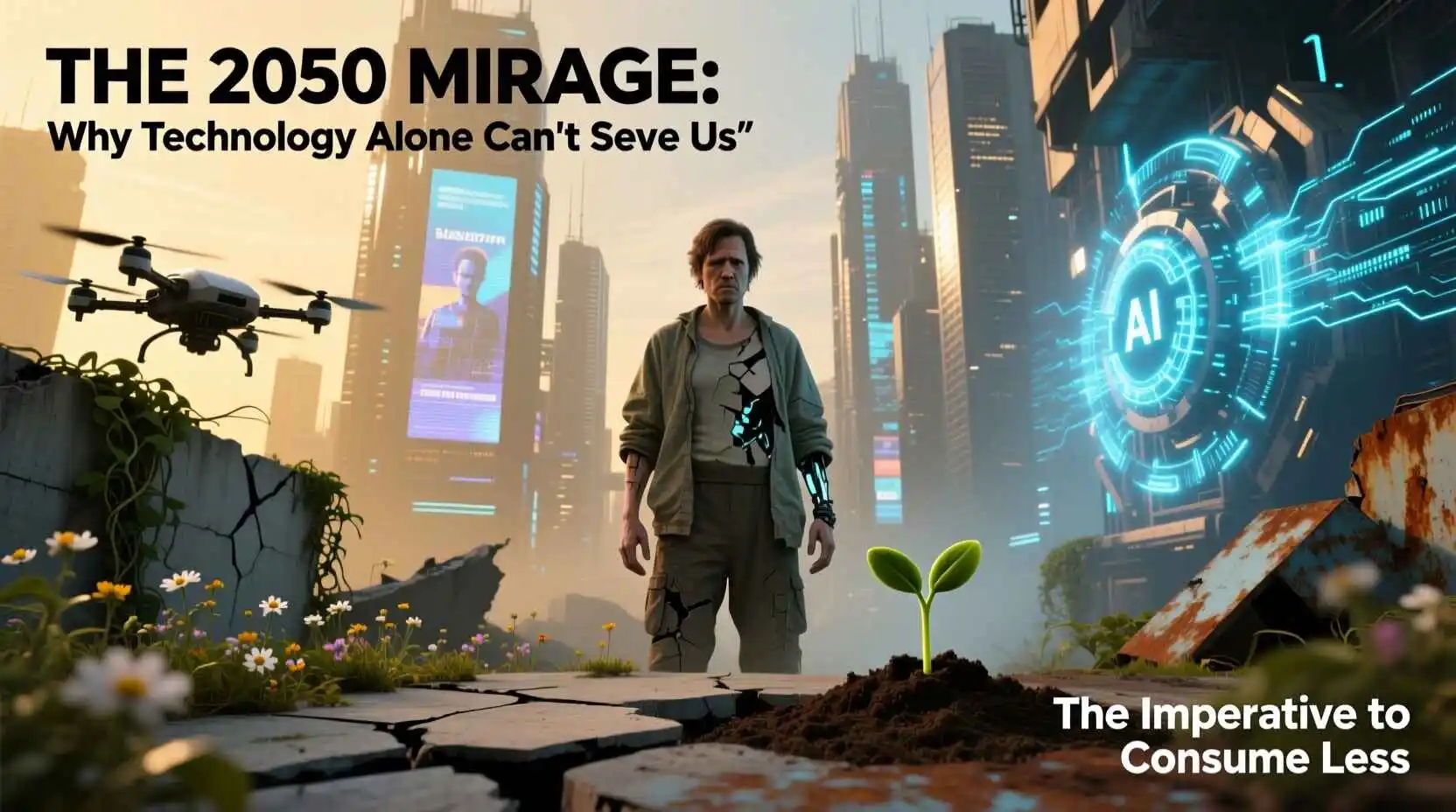
Conversely, embracing the principle of sufficiency makes the technological transition faster, cheaper, and more equitable. By reducing overall demand for energy and materials, we ease the immense pressure on the supply chains and physical infrastructure required for the green transition.
- Reducing the Scale of the Transition: If high-income nations commit to cutting their energy and material consumption by, say, 40-50%, the task of building out renewable energy systems and deploying carbon removal technologies becomes far more manageable. We would need fewer solar panels, fewer wind turbines, and fewer miles of new transmission lines. This directly addresses the timing and scale problem that plagues the technology-only narrative. A smaller transition is a faster transition.
- Freeing Up Resources for a Just Transition: The materials and financial resources saved by reducing consumption in the wealthy world could be redirected to ensure a just transition for developing nations. Instead of competing for scarce minerals like lithium and cobalt to build millions of private electric cars for the rich, those resources could be prioritized for building essential clean energy infrastructure, public transportation, and climate adaptation measures in the Global South. This is not just an ethical imperative; it is a practical necessity for achieving global climate goals.
- Reducing the Need for Risky Techno-Fixes: By cutting emissions at the source through reduced consumption, we significantly reduce our future reliance on speculative and high-risk carbon removal technologies like Direct Air Capture. Instead of betting our future on a massive, energy-intensive industrial project to clean up the atmosphere, we focus our efforts on preventing the pollution in the first place. This is a far more prudent and lower-risk strategy.
A New Economic Paradigm: Beyond Green Growth
Ultimately, the synergy between technology and sufficiency points to the need for a new economic paradigm. The current model of “green growth” assumes that we can continue to grow the global economy indefinitely while reducing environmental impacts through technological efficiency. As we have seen with the Jevons Paradox, this is a risky and likely flawed assumption.
The alternative is a model of a “post-growth” or “steady-state” economy. In this model, the goal is not to maximize GDP, but to maximize human and ecological well-being within planetary boundaries. This does not necessarily mean a shrinking economy, but rather an economy that operates within a stable scale, no longer demanding an ever-increasing throughput of energy and materials.

In a post-growth economy, success would be measured not by how much we produce and consume, but by the health of our communities, the quality of our environment, the level of equality, and the well-being of our citizens. Policies would shift from promoting consumption to promoting sufficiency. This could involve measures like:
- Shortening the Work Week: Sharing the available work more evenly, reducing unemployment and giving people more time for leisure, community, and family life.
- Universal Basic Services: Guaranteeing access to essential services like healthcare, education, housing, and transportation for everyone, decoupling well-being from individual income.
- Tax Shifting: Shifting taxes away from things we want more of, like labor and income, and onto things we want less of, like pollution, resource extraction, and carbon emissions.
- Advertising Regulation: Limiting the pervasive culture of consumerism by restricting advertising, particularly in public spaces and targeted at children.
This is a radical vision, but it is a logical conclusion from the evidence at hand. The technology-only path is a dead end. It is a fantasy that allows us to postpone the difficult but necessary conversations about the nature of our economic system and our consumerist lifestyles. By embracing a synergistic approach that combines the best of technology with the wisdom of sufficiency, we can chart a course toward a future that is not only ecologically stable but also more just, equitable, and genuinely prosperous.
FAQs
- What is the main argument against relying solely on technology to reach net-zero by 2050?
The main argument is one of scale, time, and physics. The transition required is so immense—replacing our entire global energy and material infrastructure in under 30 years—that it is practically impossible. It faces insurmountable challenges with critical mineral shortages, infrastructure lock-in, and the sheer rate of deployment needed. Relying on future, unproven carbon removal technologies adds a massive, unquantifiable risk.
- Is this an argument against renewable energy like solar and wind power?
Absolutely not. The argument is not against renewable energy; it is for it. We need an urgent, massive deployment of renewables. The point is that building a renewable energy system to power our current, unsustainable levels of consumption is a task so large it may be impossible to achieve in the timeframe required. We need both renewables and reduced consumption.
- What is the “timing problem” mentioned in the blog post?
The timing problem refers to the fact that the physical transition to a net-zero economy—building millions of wind turbines, solar panels, electric vehicles, and new grid infrastructure—is a monumental industrial undertaking that would take many decades, even under ideal conditions. The 2050 deadline is simply not enough time to complete this build-out, especially when we are still adding new fossil fuel infrastructure today.
- What is the Jevons Paradox and how does it relate to climate change?
The Jevons Paradox observes that when technology makes a resource more efficient to use, the total consumption of that resource often increases, not decreases. For example, more efficient cars can lead to more driving. In the climate context, if we only focus on making our energy use more efficient without also limiting overall consumption, we could see the efficiency gains wiped out by increased demand, leading to no net reduction in environmental impact.
- Isn’t the real problem overpopulation in the developing world?
While population is a factor in the IPAT equation (Impact = Population x Affluence x Technology), the data clearly shows that “Affluence” (consumption per person) is the dominant driver of environmental impact. The world’s richest 10% are responsible for nearly half of all emissions. A person in a high-income country has a vastly larger footprint than a person in a low-income country. Focusing only on population is a distraction from the outsized responsibility of the wealthy world.
- What does “cutting consumption” actually mean for an average person in a wealthy country?
It does not mean living in poverty. It means shifting from a high-consumption, high-waste lifestyle to one of “sufficiency.” This could mean living in a smaller, more energy-efficient home, driving less and using public transport more, flying less, eating a more plant-based diet, wasting less food, and buying fewer, more durable things. It is about living better with less.
- Will cutting consumption wreck the economy and lead to job losses?
This is a valid concern, but it assumes our current economic model is the only one possible. A transition to a low-consumption economy would be a massive restructuring, not a collapse. It would involve shifting jobs and investment away from polluting, resource-intensive industries (like fossil fuels and fast fashion) towards sustainable ones (like renewable energy, public transit, regenerative agriculture, and the care economy). The goal is a “just transition” that supports workers and communities through the change.
- What is the difference between “efficiency” and “sufficiency”?
Efficiency is about doing the same thing with less energy or material (e.g., a more fuel-efficient car). Sufficiency is about questioning whether you need to do the thing at all, or if you can have your need met in a different way (e.g., walking, biking, or taking the bus instead of driving). Efficiency is a technological solution; sufficiency is a social and behavioral one. We need both.
- Isn’t it unfair to ask people in wealthy countries to cut consumption when people in developing countries want to improve their standard of living?
It is not about asking anyone to live in poverty. It is about recognizing that the current development path, modeled on high-consumption Western lifestyles, is not sustainable for the planet. The wealthy world has a moral obligation to reduce its own footprint to create the ecological space for developing nations to meet their basic needs and prosper in a sustainable way. This is a matter of global climate justice.
- What role does government policy play in encouraging lower consumption? Government policy is crucial. Governments can shift taxes from goods (like income) to bads (like carbon and pollution). They can invest heavily in public services like high-quality public transport, healthcare, and education. They can regulate advertising, promote the “right to repair,” and set strong standards for energy efficiency and product durability. Policy can make sustainable choices the easy and affordable choices for everyone.
- Can individual actions really make a difference when corporations and governments are the biggest polluters?
This is a false dichotomy. Individual actions and systemic change are not mutually exclusive; they are mutually reinforcing. Individual actions create the cultural and political mandate for systemic change. When millions of people change their behavior, it signals to businesses and governments that there is a demand for change. Furthermore, in many high-emitting countries, household consumption is a major driver of national emissions, so individual changes do have a significant aggregate impact.
- What is “sufficiency” and is it just another word for austerity?
Sufficiency is about having enough to live a good life without transgressing planetary boundaries. Austerity is typically a top-down policy of enforced scarcity, often imposed on the poor during economic downturns. Sufficiency, by contrast, is about a conscious, voluntary choice to focus on non-material sources of well-being, like community, health, and purpose. It is a vision of abundance, not scarcity.
- What about carbon removal technologies like Direct Air Capture?
Can’t they just clean up our emissions? Relying on carbon removal is a massive and dangerous gamble. These technologies are currently extremely expensive, energy-intensive, and unproven at the scale required. Betting our future on them is like continuing to set your house on fire because you hope someone will invent a perfect fire extinguisher in the future. We must prioritize cutting emissions at the source. Carbon removal should be reserved for the very hardest-to-abate sectors.
- Does this mean we have to give up air travel forever?
Not necessarily forever, but it does mean a dramatic and immediate reduction, especially for discretionary and short-haul flights. Air travel has an enormous carbon footprint. For the foreseeable future, it will remain a luxury activity with a high environmental cost. A shift to “slow travel”—trains, buses, and exploring local destinations—is a necessary part of a low-consumption lifestyle.
- How does our food system contribute to the problem, and what can be done? Industrial agriculture, particularly animal agriculture, is a major driver of deforestation, biodiversity loss, and greenhouse gas emissions. The most impactful changes are shifting towards a more plant-based diet, drastically reducing food waste, and supporting local, regenerative farming practices that build soil health instead of depleting it.
- Isn’t a growing economy necessary for social progress and innovation?
While economic growth has been correlated with social progress in the past, we are reaching the point where the costs of continued growth (climate change, resource depletion, social inequality) are beginning to outweigh the benefits. A “post-growth” or “steady-state” economy would focus on improving well-being directly, through better health, education, and equality, rather than through the proxy of GDP.
- What is a “steady-state economy”?
A steady-state economy is an economy that maintains a stable level of material and energy throughput. It does not aim for constant GDP growth. Instead, it seeks to operate within the Earth’s ecological capacity, focusing on qualitative development (improving quality of life) rather than quantitative growth (increasing the scale of the economy).
- Won’t corporations just find a way to profit from a “sufficiency” economy?
Some will, and some will not. A sufficiency economy would fundamentally change what is profitable. Businesses that provide durable, repairable goods, services that enhance community and well-being, and solutions for sharing resources would thrive. Businesses built on a model of planned obsolescence, disposability, and endless novelty would struggle. The role of government would be to create the rules that favor the former.
- What is the “Right to Repair” and why is it important?
The Right to Repair is the concept that consumers should be able to fix the products they own. It is important because many manufacturers design products to be difficult or impossible to repair, forcing consumers to buy new ones. This creates massive amounts of electronic waste and drives unnecessary consumption. Enshrining the right to repair in law would make products last longer, saving resources and money.
- How can we have a conversation about cutting consumption without sounding judgmental or elitist?
The conversation must be framed around justice, community, and well-being, not sacrifice. It should highlight the benefits of a low-consumption life: less stress, more free time, stronger communities, better health. It must acknowledge that systemic change is needed to make sustainable choices the easy choices for everyone, not just the privileged few. The focus should be on creating a system that works for all, not on shaming individuals.
- What is the role of cities in promoting lower consumption?
Cities are critical. Well-designed cities can drastically reduce the need for energy and material consumption. This means investing in dense, mixed-use neighborhoods where people can walk or bike to meet their daily needs. It means building world-class public transportation systems. It means creating green spaces and fostering a sense of community that reduces the desire for material consumption.
- Is it possible to achieve a high quality of life with a much smaller ecological footprint? Yes, absolutely. Numerous studies, including the Happy Planet Index, show that there is no direct correlation between high GDP per capita and high life satisfaction. Many countries with much lower consumption levels report levels of well-being equal to or greater than those in high-consuming nations. Quality of life is determined by factors like social support, health, freedom, and trust, not just material wealth.
- What about new technologies like nuclear fusion or advanced geothermal?
Could they solve the energy problem? While we should continue to research and develop all promising clean energy technologies, we cannot bank on a miracle breakthrough. Fusion, for example, has been “50 years away” for decades. We have to make policy decisions based on the technologies we have today that are proven and scalable, which are renewables like solar, wind, and geothermal. We must plan for the future we have, not the future we wish for.
- How does advertising contribute to overconsumption?
Advertising is the engine of consumerism. Its primary function is to create desires where none previously existed, to make people feel dissatisfied with what they have, and to link happiness and identity to the consumption of products. The hundreds of billions of dollars spent on advertising each year create a powerful cultural current that pushes us all towards overconsumption.
- What is the difference between a “green growth” strategy and a “post-growth” strategy?
A “green growth” strategy aims to continue growing the global economy while reducing environmental impacts through technological efficiency and a switch to renewables. A “post-growth” strategy argues that this is not possible on a finite planet and instead aims to stabilize the size of the economy and focus on improving well-being and equity within ecological limits.
- What can I do today to start reducing my consumption in a meaningful way?
Start with a personal audit. Look at your biggest sources of emissions: home energy, transport, and food. Make one change in each area. Switch to a green energy provider, commit to taking public transport or biking one day a week, and try having one meat-free day a week. Focus on progress, not perfection. The most important step is to begin the journey of mindful consumption.
- Won’t China and India just keep polluting no matter what we do?
This is a global problem that requires a global solution. However, as historically high emitters, wealthy nations have a moral responsibility to lead by example and drastically reduce their own emissions first. Furthermore, China and India are investing massively in renewable energy. The argument that “they are not acting, so why should we?” is a formula for global inaction and collective failure.
- How does cutting consumption relate to other environmental problems, like biodiversity loss and plastic pollution?
Climate change is not an isolated problem; it is a symptom of a larger systemic issue: human overconsumption of the planet’s resources. The same drivers—fossil fuel use, industrial agriculture, deforestation, a throwaway culture—are responsible for climate change, biodiversity loss, plastic pollution, and ocean acidification. Cutting consumption addresses the root cause of all these crises simultaneously.
- Is this a call for a return to a pre-industrial, agrarian lifestyle?
No. This is a call for a forward-looking, high-tech, low-consumption society. We can and should use the best of modern technology—from renewable energy and the internet to advanced medicine and materials science—to build a society that is both ecologically sustainable and provides a high quality of life for all. It is about using technology wisely, not as a substitute for responsibility.
- What is the single most important takeaway from this discussion?
The single most important takeaway is that we have been sold a false choice: either we continue with business-as-usual and face climate catastrophe, or we pin all our hopes on a technological silver bullet that will allow us to continue business-as-usual. There is a third, more realistic, and more desirable path: one that combines a rapid technological transition with a conscious, collective commitment to consuming less. This path is not about sacrifice; it is about building a better, more just, and more fulfilling world for everyone.
Disclaimer: The content on this blog is for informational purposes only. Author’s opinions are personal and not endorsed. Efforts are made to provide accurate information, but completeness, accuracy, or reliability are not guaranteed. Author is not liable for any loss or damage resulting from the use of this blog. It is recommended to use information on this blog at your own terms.


